
By Rakhee Naik. South Africans are watching every rand, but they’re still willing to spend more – on the right thing.
New YouGov Profiles data from consumer insights agency KLA shows that South Africans are paying closer attention to price than they were three years ago. But they are not simply choosing the cheapest option. Quality, brand trust, and the sense of getting something worthwhile in return are still important.
The study tracks internet-connected South African adults aged 18+ and looks at how they think about price, value and quality. It draws on both a nationally representative view of the population and the segment of South Africans who say their household financial situation is better now than a month ago. Comparisons against April 2023 are also included, to track how sentiment has changed over time.
Quality has become the price of entry
South Africans are making their money work harder. Nationally, 84% say they make sure to use all sales, coupons and deals when they shop – up from 75% in 2023. Another 74% usually look for the lowest prices when going shopping, 73% always have a shopping list when going grocery shopping, and 74% say they are more careful with their finances than they used to be. Looking ahead, 82% are planning to save more money next year.
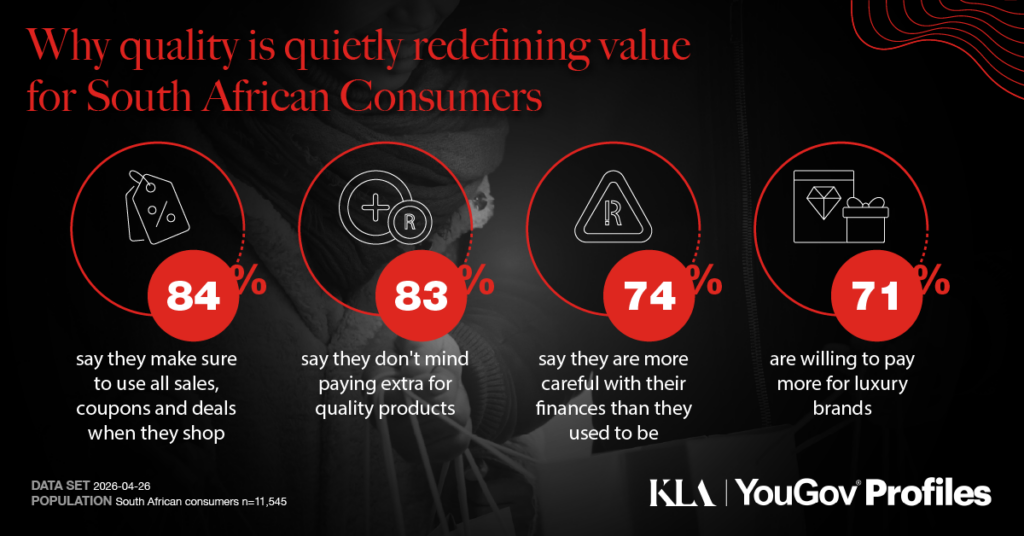
But this does not mean consumers are only looking for the cheapest option. Some 83% say they don’t mind paying extra for good quality products, while 71% are willing to pay more for luxury brands. South Africans will still spend, but they want the price to feel justified. Quality has become the price of entry.
Consumers feel better off — cautiously
Financial sentiment has also improved. Today, 60% of South Africans now consider themselves financially secure, up from 48% three years ago. But only 54% feel confident they could handle a personal financial crisis, with 23% sitting on the fence. The picture is one of cautious optimism rather than runaway confidence, and it helps explain why deal-hunting and quality-seeking are co-existing in the same consumer.
Among South Africans who say they are better off than they were a month ago, the value-quality tension sharpens. This isn’t a group that has stopped looking for deals: 88% use all sales, coupons and deals when shopping, against 84% nationally, with 59% definitely agreeing. They subscribe to loyalty programmes (86%) and overwhelmingly believe these are a great way for brands to reward customers (90%).
Value still comes first
This group is also noticeably more willing to pay up on brands they trust: 79% are willing to pay more for luxury brands, against 71% nationally, with 55% definitely agreeing. Some 87% don’t mind paying extra for good quality products. They are more likely to choose premium products and services (65% vs 56%), and more likely to stick to best-known brands (73% vs 66%).
There’s a more impulsive streak here too: 62% say they tend to make impulsive purchases, against 54% nationally, and 63% admit to buying beautiful but non-essential things, compared to 54% in the broader population. The headline for this group is that they are value-seeking and premium-leaning at the same time. They’re still squeezing every coupon, but they’re also more willing to back a brand they trust with a higher spend, and to add a few ‘nice-to-have’ items along the way.
Younger consumers are spending more
Demographically, this group skews younger and more urban: 39% are aged 25 to 34, compared to 32% nationally, and 25% are 35 to 44. The over-45s are notably under-represented at 12%, against 20% in the population. The gender split is roughly in line with the national average at 48% male and 52% female.
They are also more likely to fall into higher-income households (28% vs 22% nationally) and to have stronger tertiary qualifications, with 52% holding a Bachelor degree or higher, against 47% across the population. They tilt slightly to Gauteng (42% vs 40%) and KwaZulu-Natal (19% vs 17%), and are under-represented in the Eastern Cape (10% vs 14%).
So, this is a younger, urban-leaning, more educated consumer with a stronger income base. They are the consumers most likely to keep paying more when the brand, product or experience earns it.
Media is mixed but TV still matters
The media profile of this group has implications worth weighing up. Their internet usage looks very similar to the national average across email (85% vs 88%), online banking (80% in both groups), general browsing (67% vs 70%) and streaming video (60% vs 62%). Where they differ is in TV and mobile: 71% are heavy-frequency TV viewers, against 66% nationally, a small but meaningful skew.
On mobile, their app usage is also slightly higher at the top end: 6% have between 76 and 100 apps installed (vs 3% nationally) and 5% have more than 100 (vs 3%). They are also slightly less likely than the population to select social networking (40% vs 47%) or video and music streaming (34% vs 39%) as regular channels visited.
For media planners, that points away from a purely social-or streaming-led plan if you want to reach this segment at scale. The broader implication is that activating value-and-quality consumers means leaning on TV plus mainstream digital, rather than chasing them through narrower channels.
The South African consumer hasn’t stopped asking what something costs — they’ve started asking harder questions about what they get back. Sales, coupons and shopping lists aren’t going anywhere. But the willingness to pay more for the right brand, the right experience and the right reward is rising, and it’s most pronounced among the consumers whose financial situation is improving. The opportunity for brands is to lead with a value story rather than just a price story, and to find these consumers where they actually spend their media time.
Methodology
YouGov Profiles: Segmentation and media planning tool providing a comprehensive view of consumers’ worlds, with data collected daily.
Population: South African adults with access to the internet, aged 18+.
Sample sizes: 2023 n~4,395; 2026 National Population n~11,545; Household financial situation better than last month n~5,956.
Datasets: Profiles+ South Africa, 2026-04-26 and 2023-04-23.
Rakhee Naik is a managing consultant: Insights at KLA.


