

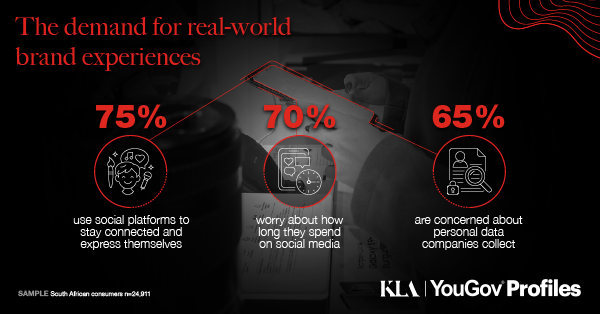
By Rakhee Naik. South Africans are feeling a growing tension with their digital lives. About 70% worry about how long they spend on social media, while nearly 65% are concerned about the data companies collect. This is according to research from consumer insights agency KLA, using YouGov Profiles data (tracking internet-connected adults aged 18+).
This digital fatigue is opening the door for experiential marketing as consumers look for more grounded, human brand interactions.
The study shows that although South Africans are more connected than ever, many are increasingly drawn to real-world experiences that restore a sense of control and authenticity in their relationship with brands.
Digital fatigue creates new marketing opportunities
While technology makes it easier to access information and services, consumers are becoming more wary of its impact on their emotional well-being. Many say the internet has made people feel less connected despite promising the opposite.
At the same time, a similar proportion of consumers are unwilling to let anyone see their browsing history, showing how scarce trust has become.
In a space where digital engagement often feels transactional, real-life activations offer a moment of transparency. Rising data anxiety is changing how consumers interpret brand interactions, with many feeling that online tracking has gone too far.
A physical experience is free from algorithms, hidden data mining, and targeted surveillance. When a brand shows up in a tangible way, consumers are more willing to listen, participate, and remember. In a privacy-conscious era, experiential marketing becomes more than a campaign tactic. It becomes a way to build trust and stand out.
Technology should enhance, not replace experiences
Despite this fatigue, consumers are not anti-technology. Many see artificial intelligence as part of human progress, and recognise the value of augmented and virtual reality in helping them understand products before they buy.
When technology supports an experience rather than taking over, engagement increases naturally. Consumers appreciate immersive tools when they do not feel intrusive.
And the purchase journey is no longer linear. Consumers browse online, compare in person, return to an app, or choose click-and-collect depending on what feels easiest in the moment. This fluidity makes experiential marketing highly effective because it interrupts the cycle with a moment that has emotional weight.
A powerful in-person interaction can shape consideration long before a consumer reaches checkout, allowing them to visualise how a product or service fits into their life in ways standard digital advertising cannot replicate.
Shared moments extend brand impact online
Around 75% of South Africans use social platforms to stay connected and express themselves, which means a memorable real-world activation naturally multiplies its reach. People photograph it, talk about it and turn it into content without being prompted.
Experiential marketing doesn’t rely on forced virality. It relies on genuine excitement, and that excitement carries itself into the digital world through authentic storytelling from consumers.
 Emotional resonance drives deeper engagement
Experiences stand out because they create emotional memories. When digital content feels repetitive or overly targeted, consumers may feel detached. But a live event, a hands-on activity or a sensory moment triggers connection.
The data shows that people are hungry for pleasure, meaning and connection, and experiential marketing taps into all three simultaneously. It gives consumers stories to tell rather than ads to skip.
The shift toward mindful digital behaviour
There is a clear move toward more intentional internet use. Many express concern about privacy, screen time and the emotional effects of online life. This growing mindfulness is making consumers more selective about the brands they invite into their digital spaces. Experiential marketing provides an alternative pathway to connection, allowing brands to meet consumers in a space where they feel mentally present rather than digitally overloaded.
The data signals that consumers want real connections, emotional depth, and meaningful interactions. They’re looking for brands to meet them in spaces where they feel human again, not just monitored.
As digital fatigue rises and privacy concerns grow, experiential marketing offers a powerful complement to digital strategies. It’s not about replacing digital touchpoints, but about adding layers of engagement that build authenticity, trust, and memorable experiences. In 2026, brands that combine experiential and digital engagement will best capture the attention and affection of consumers craving more than just another online interaction.
The study utilised YouGov Profiles+ South Africa data collected on 30 November 2025, with a nationally representative sample of n=24,911 adults.
Rakhee Naik is a managing consultant: Insights at KLA.


