
By Rakhee Naik. South Africans love cooking and culinary exploration, but real-world pressures are changing how, when and what they eat.
For many households, food is more than fuel. It’s creativity, comfort, and connection. Yet time and money create barriers between aspiration and action. Consumer insights company KLA conducted a study with data from YouGov Profiles (tracking internet-connected adults aged 18+), examining behaviour around eating at home versus dining out. The results show passionate home cooks managing busy lives, with income and health patterns impacting their choices.
A nation of passionate home cooks
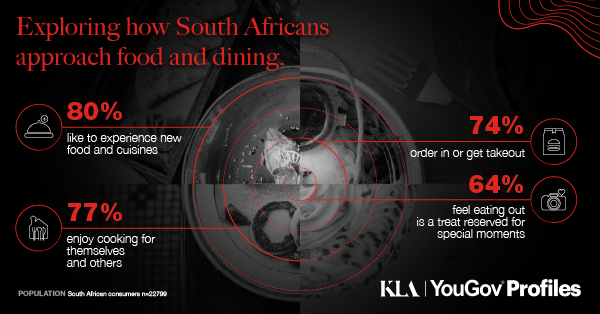
Cooking is the top activity people like to do in their spare time at 58%, ahead of reading, watching TV, DIY, and arts and crafts. It’s also not just a passive interest but representative of connection: 77% of respondents say they enjoy cooking for themselves and others.
The appetite for exploration is just as strong, with 80% of respondents noting that they like to experience new food and cuisines. This is a sign of eaters eager to expand their palates, and it appears the desire to discover new flavours is embedded in South African food culture.
But the practical realities of daily life complicate things. Almost half of respondents (46%) feel their lifestyle doesn’t allow them time to prepare and cook food, while 40% state it’s more convenient to eat on the go than to sit down for a traditional meal. So, while South Africans love cooking, many struggle to find the time.
When real life gets in the way
This time pressure looks different across the population, and there’s nuance in how South Africans actually eat. Despite busy schedules, 78% of respondents say they usually sit down together for a meal at home. Shared mealtimes remain a priority, even when cooking time is tight.
At the same time, convenience plays a strong role: 74% of respondents agree that they usually order in or get take out, while 71% agree that they often order takeaway food. These aren’t contradictory behaviours but complementary ones — ordering in may be precisely what allows busy households to maintain those shared mealtimes.
When it comes to restaurant dining, a pattern emerges around special occasions. 64% of respondents agree that eating out is a treat reserved for special moments, even while 61% agree that they like to go to trendy restaurants. South Africans appreciate quality dining experiences but frame them as celebratory rather than routine, a mindset that has implications for restaurant marketing and positioning.
Health and fast food
Health adds another layer. People who rate themselves as healthier are less likely to buy fast food each month. The proportion who never buy fast food at all increases the higher someone rates their own health. In short: the healthier people feel, the less fast food they buy.
What’s more, 41% of respondents say they don’t eat junk food and don’t allow their family to eat it either, suggesting a meaningful segment of the population takes a deliberate approach to what ends up on the table.
More frequent fast-food purchases (more than once a month) appear among higher household income (HHI) groups. While monthly buying remains fairly consistent across income bands, the percentage of respondents who never purchase fast food declines as household income rises.
- HHI <10k: 48% never purchase
- HHI 10-20k: 37% never purchase
- HHI 20-40k: 28% never purchase
- HHI 40-70k: 28% never purchase
- HHI 80-120k: 29% never purchase
- HHI 120k+: 23% never purchase
For lower income households, avoiding fast food likely reflects budget constraints more than preference — it’s discretionary spending that isn’t always available.
On grocery shopping, just under a third of respondents say their purchases are evenly split between online and in-store, reflecting how these two channels continue to merge.
👉 See more KLA insights
- South African generational retail marketing statistics (Feb 2025)
- Inside South Africa’s loyalty boom (Nov 2025)
- South African consumer attitudes to advertising (Sept 2025)
What the numbers mean for food brands
For brands in the food space, a few things stand out. South Africans are passionate about cooking and open to trying new flavours. Products and services that enhance home cooking experiences will find a ready audience. And time-saving solutions that maintain quality will resonate strongly with households feeling stretched.
Restaurant and fast food brands should take note of how firmly dining out is framed as a special occasion. Marketing that leans into celebration and treat territory aligns with how consumers already think about it.
What the data ultimately shows is a population that wants to cook, wants to explore, and wants to eat together, but needs some help making that happen. The brands that get this right won’t just sell products; they’ll solve for the gap between their food aspirations and their daily realities.
Methodology:
YouGov Profiles+: Segmentation and media planning tool providing comprehensive consumer insights with data collected daily. The tool offers powerful capabilities to build and customise detailed portraits of consumer behaviour and preferences.
Sample n=22799.
MAPs DataSet Q3.
Rakhee Naik is a managing consultant: Insights at KLA.


